Problem S5: Triangle: The Data Structure
2019 · S5 · Original problem · DMOJProblem Description
In a parallel universe, the most important data structure in computer science is the triangle. A triangle of size consists of rows, with the -th row containing elements. Furthermore, these rows must be arranged to form the shape of an equilateral triangular. That is, each row is centered around a vertical line of symmetry through the middle of the triangle. For example, the diagram below shows a triangle of size 4:
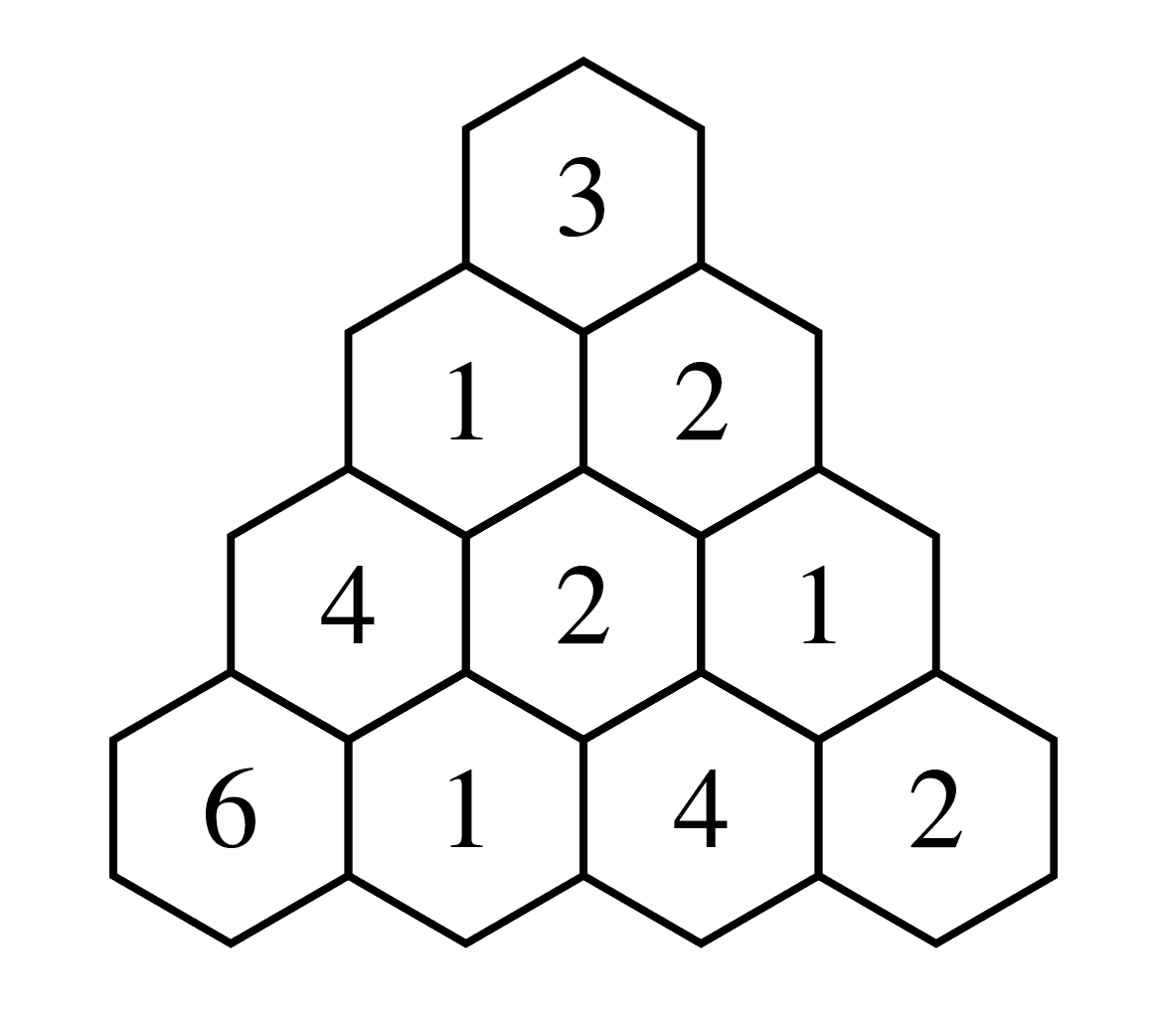
A triangle contains sub-triangles. For example, the triangle above contains ten sub-triangles of size 1, six sub-triangles of size 2 (two of which are the triangle containing and the triangle containing ), three sub-triangles of size 3 (one of which contains ). Note that every triangle is a sub-triangle of itself.
You are given a triangle of size and must find the sum of the maximum elements of every sub-triangle of size .
Input Specification
The first line contains two space-separated integers and .
Following this are lines describing the triangle. The -th of these lines contains space-separated integers , representing the -th row of the triangle.
For 4 of the 15 available marks, .
Output Specification
Output the integer sum of the maximum elements of every sub-triangle of size .
Sample Input
4 2
3
1 2
4 2 1
6 1 4 2
Output for Sample Input
23