Problem J5: Nailed It!
2017 · J5 · Original problem · DMOJTime limit: 2 seconds
Problem Description
Tudor is a contestant in the Canadian Carpentry Challenge (CCC). To win the CCC, Tudor must demonstrate his skill at nailing wood together to make the longest fence possible using boards. To accomplish this goal, he has pieces of wood. The piece of wood has integer length .
A board is made up of exactly two pieces of wood. The length of a board made of wood with lengths and is . A fence consists of boards that are the same length. The length of the fence is the number of boards used to make it, and the height of the fence is the length of each board in the fence. In the example fence below, the length of the fence is 4; the height of the fence is 50; and, the length of each piece of wood is shown:
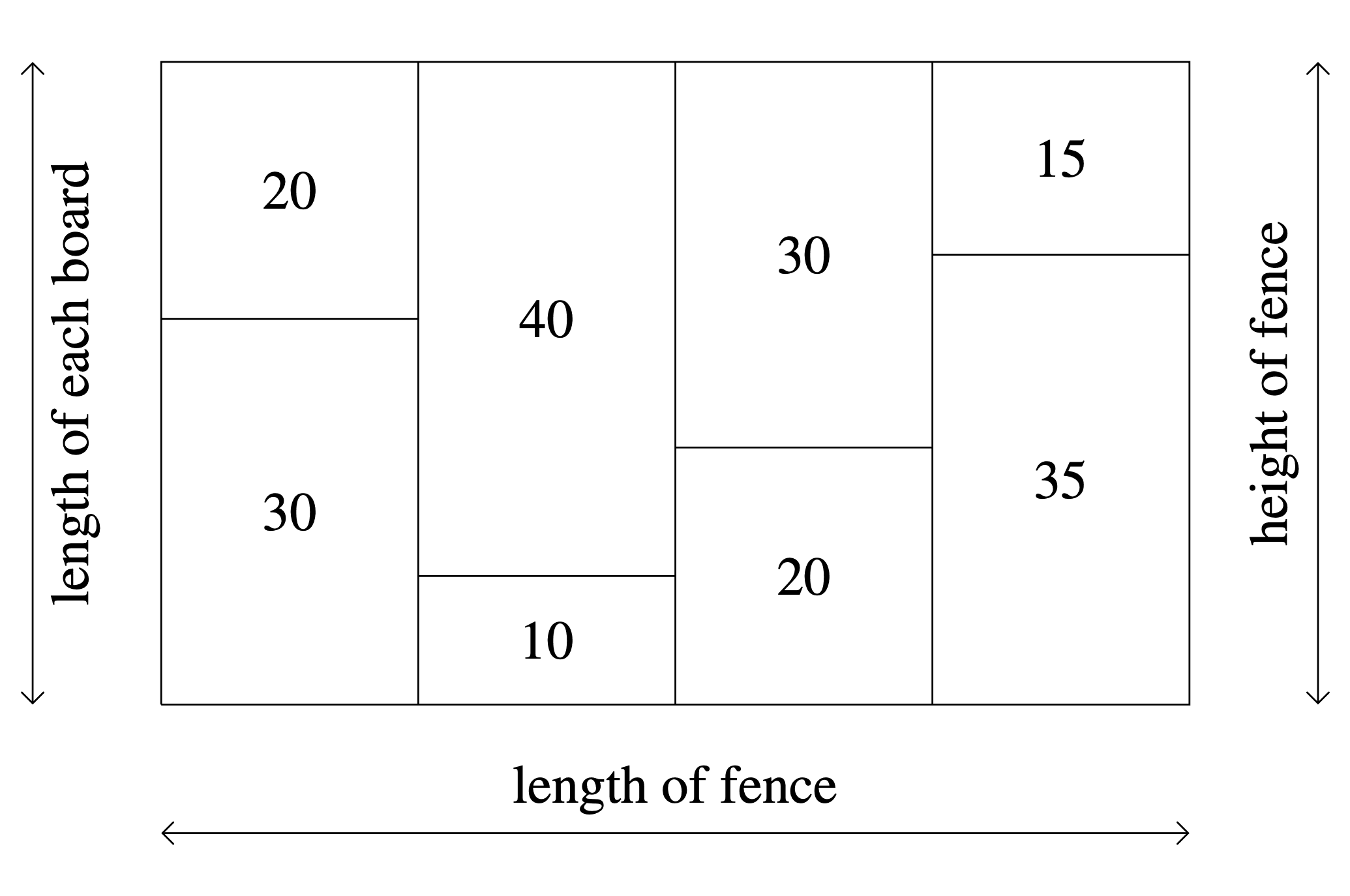
Tudor would like to make the longest fence possible. Please help him determine the maximum length of any fence he could make, and the number of different heights a fence of that maximum length could have.
Input Specification
The first line will contain the integer .
The second line will contain space-separated integers .
For 7 of the 15 available marks, .
For an additional 6 of the 15 available marks, .
For an additional 1 of the 15 available marks, .
Output Specification
Output two integers on a single line separated by a single space: the length of the longest fence and the number of different heights a longest fence could have.
Sample Input 1
4
1 2 3 4
Output for Sample Input 1
2 1
Explanation for Output for Sample Input 1
Tudor first combines the pieces of wood with lengths and to form a board of length . Then he combines the pieces of wood with lengths and to form another board of length . Finally, he combines the boards to make a fence with length and height .
Sample Input 2
5
1 10 100 1000 2000
Output for Sample Input 2
1 10
Explanation for Output for Sample Input 2
Tudor can’t make a fence longer than length , and there are ways to make a fence with length by choosing any two pieces of wood to nail together. Specifically, he may have a fence of height 11, 101, 1001, 2001, 110, 1010, 2010, 1100, 2100 and 3000.